Bandbreite
Glossar Seite
Die Bandbreite bezeichnet den Frequenzbereich, in dem elektrische Signale übertragen werden. Eine größere Bandbreite ermöglicht die Übertragung einer größeren Menge an Informationen pro Zeiteinheit. Daher hat die Bandbreite einen direkten Einfluss auf die Download-Geschwindigkeit und die Geschwindigkeit, mit der Webseiten aufgebaut werden. Im Zusammenhang mit der Übertragung digitaler Signale wird oft der Begriff Bandbreite verwendet, obwohl in der Regel die Übertragungsrate oder Datenrate gemeint ist. Dennoch gibt es einen Zusammenhang zwischen der Bandbreite und der Übertragungsrate, da die erreichbare Übertragungsgeschwindigkeit von der Bandbreite und der Codierung abhängt.
https://www.itwissen.info
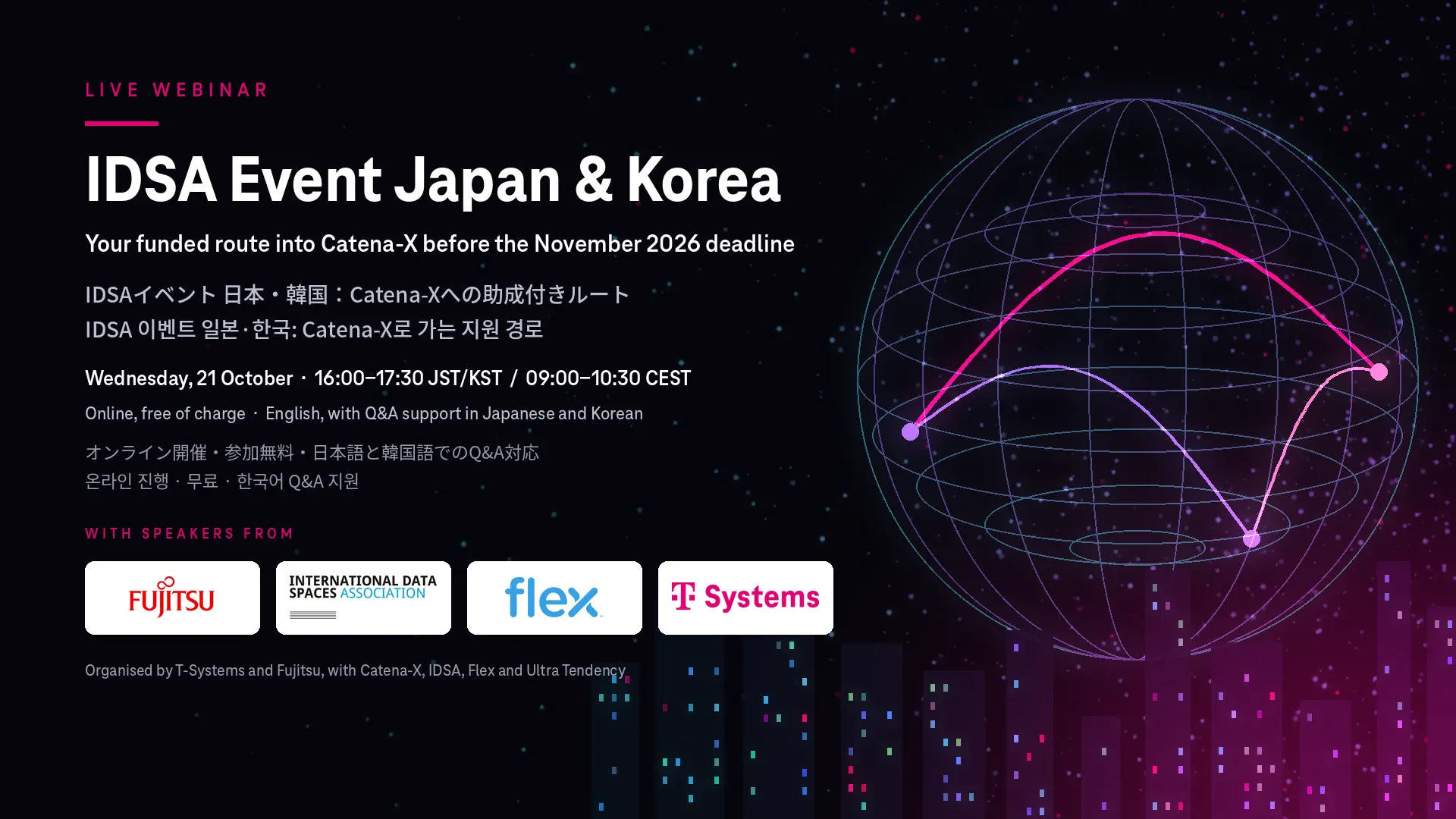
Aktuelle Webinare


Aktuelle Artikel
T-Systems Connect & Integrate is now Catena-X Titan-certified for Product Carbon Footprint
T-Systems Connect & Integrate has been certified for the Product Carbon Footprint use case under the latest Catena-X Titan release, supporting standardized exchange of product-level carbon data according to PCF rulebook 4.0 and Catena-X standard CX-0136. As OEMs come to depend on reliable and traceable CO₂ information from their supply chains, suppliers need a practical way to provide it without building and operating dataspace infrastructure themselves. Delivered as a managed, cloud-agnostic service, Connect & Integrate covers the path from collecting and preparing carbon information through to securely sharing it with business partners — a step from isolated sustainability reporting toward interoperable Scope 3 and product-level carbon data chains. The certification adds to a portfolio spanning advisory, onboarding, connectivity and productive business applications, including Company Certificate Management and Traceability, positioning T-Systems as a single partner across the whole Catena-X journey. The capability is already in use, with T-Systems supporting Ford in connecting more than 70 suppliers worldwide to Catena-X.
Weiterlesen

Tushar Yadav
06. Okt. 2026
From certificate exchange to certificate management and control: Connect & Integrate moves into the next generation of enterprise-scale certificate management
Exchanging a certificate through Catena-X is only the first step. For automotive suppliers managing growing certificate portfolios, the real work lies in maintaining certificates across sites and business partners, monitoring expiry dates, tracking what has been published and acting on OEM responses. Connect & Integrate from T-Systems is evolving from a certificate exchange solution into an enterprise-ready certificate control system: a central cockpit for inventory and lifecycle activities, dedicated certificate and site views, a consolidated view of partner responses, site information drawn from Cofinity-X, and detailed technical logs when auditing is required. Combined with AI-assisted preparation already in production across hundreds of customers, it creates one connected journey from preparing certificate data to controlling what happens across the entire certificate lifecycle.
Weiterlesen
Tushar Yadav
02. Okt. 2026
Build & Operate: From Kubeapps to Devtron
When VMware deprecated and archived Kubeapps, the open-source Helm application manager embedded in T-Systems Build & Operate, we had a choice: stay on unsupported software or find something better. We chose Devtron, an open-source Kubernetes management platform that gives dataspace operators one control plane for application delivery, infrastructure, security and observability. This article explains why Kubeapps reached the end of its life, what Devtron brings to the Build & Operate operation toolkit, and how the transition runs in two phases without interrupting a single running service.
Weiterlesen

Mohamed Radwan
29. Sept. 2026