Verifiable Credential
Glossary page
A verifiable credential includes subject identification, issuing authority, credential type, asserted attributes, derivation evidence, and constraints, mirroring physical credentials. Utilizing technologies like digital signatures, verifiable credentials surpass physical ones in security and tamper resistance. Credential holders can generate and share verifiable presentations to demonstrate specific characteristics. Both can be swiftly transmitted, enhancing remote trust establishment. The specification strives to harmonize the simplicity of expressing digital credentials with privacy considerations, tackling issues related to data persistence and correlation. The term "verifiable" pertains to a credential's verifiability by a verifier, without implying the truth of claims, empowering verifiers to assess based on provided evidence.
https://www.w3.org/TR/vc-data-model-2.0/#what-is-a-verifiable-credential
Latest webinars



Latest articles
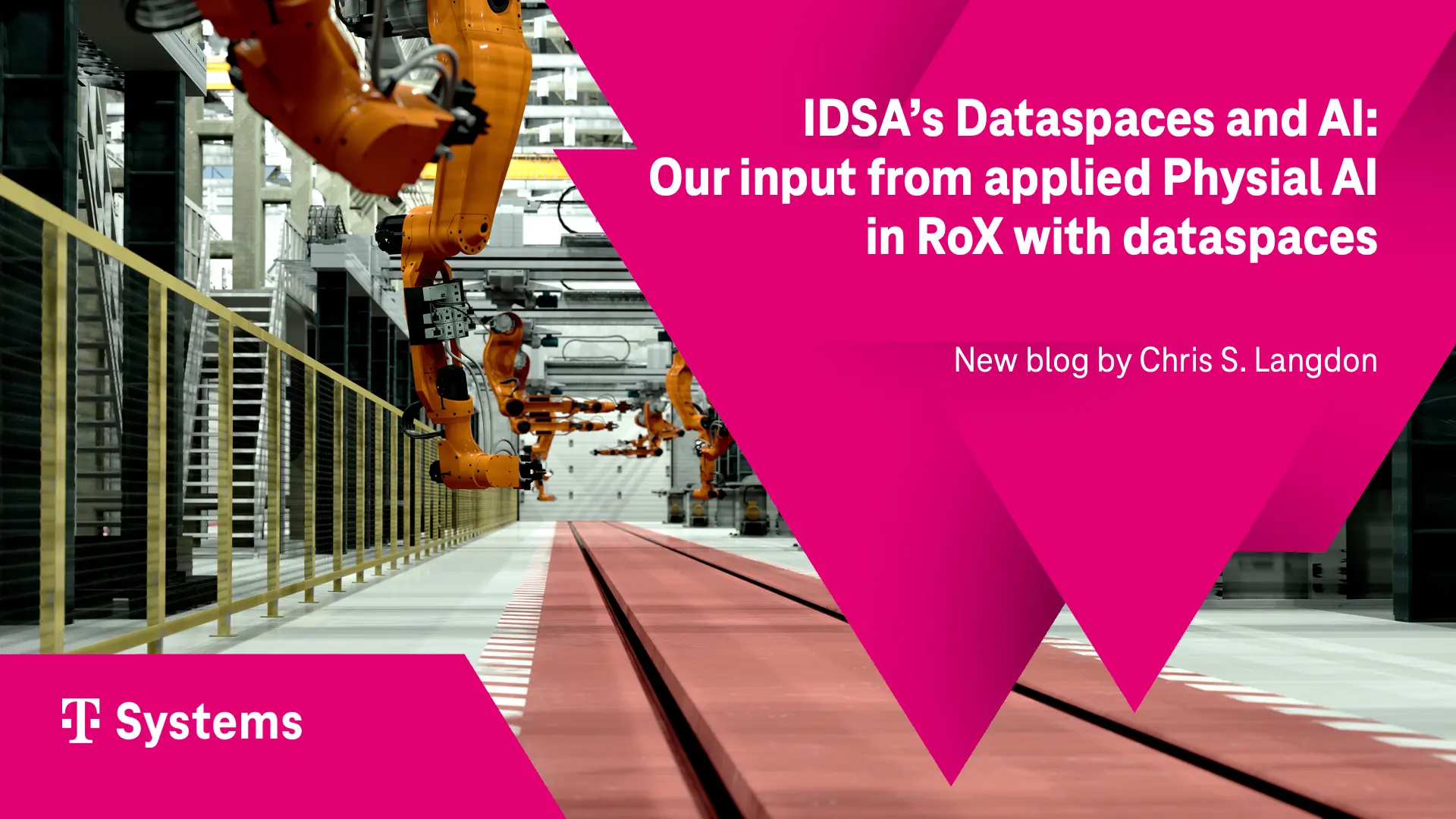
IDSA’s Dataspaces and AI: Our input from applied Physial AI in RoX with dataspaces
The IDSA position paper "Data Spaces and AI" argues that the coordination problems facing agentic AI — identity, trust, access control, governance and provenance across organizational boundaries — are the same ones dataspaces already solve for cross-company data sharing. Rather than reinventing them for autonomous agents, the peer-to-peer logic behind standards like ISO/IEC 20151 can transfer directly to agent-to-agent interaction. T-Systems contributes a concrete proof point: RoX, a German consortium where competing robotics players and institutes such as DFKI and DLR share a sovereign data foundation for AI-based robotics. Built on Tractus-X and aligned with IDSA and Gaia-X, it already powers live robotic cells and is now extending that governed data supply to an agentic layer — showing in practice what the paper argues in principle.
Read more

Chris S. Langdon
Jul 21, 2026
First Korea–Europe peer-to-peer dataspace transaction: L&F and EU Tier 1
In November 2025, the first peer-to-peer dataspace transaction between Korea and Europe was completed, with L&F (Korea) sharing product carbon footprint data with the automotive division of a major European Tier 1. Orchestrated by Prof. Chaisung Lim of Konkuk University and enabled by T-Systems' Dataspace-as-a-Service, the exchange ran on the Eclipse Tractus-X stack with the IDSA protocol and Gaia-X trust framework — the same standards underpinning Catena-X. The transaction proves that sovereign, governed data sharing can now travel across regions and regulatory environments without centralising data or surrendering control. Beyond secure, trusted file transfer, it points to a strategic foundation for AI-ready data and new value-creation scenarios, including controlled collaboration across ecosystems and even between competitors.
Read more
Chris S. Langdon
Jun 29, 2026
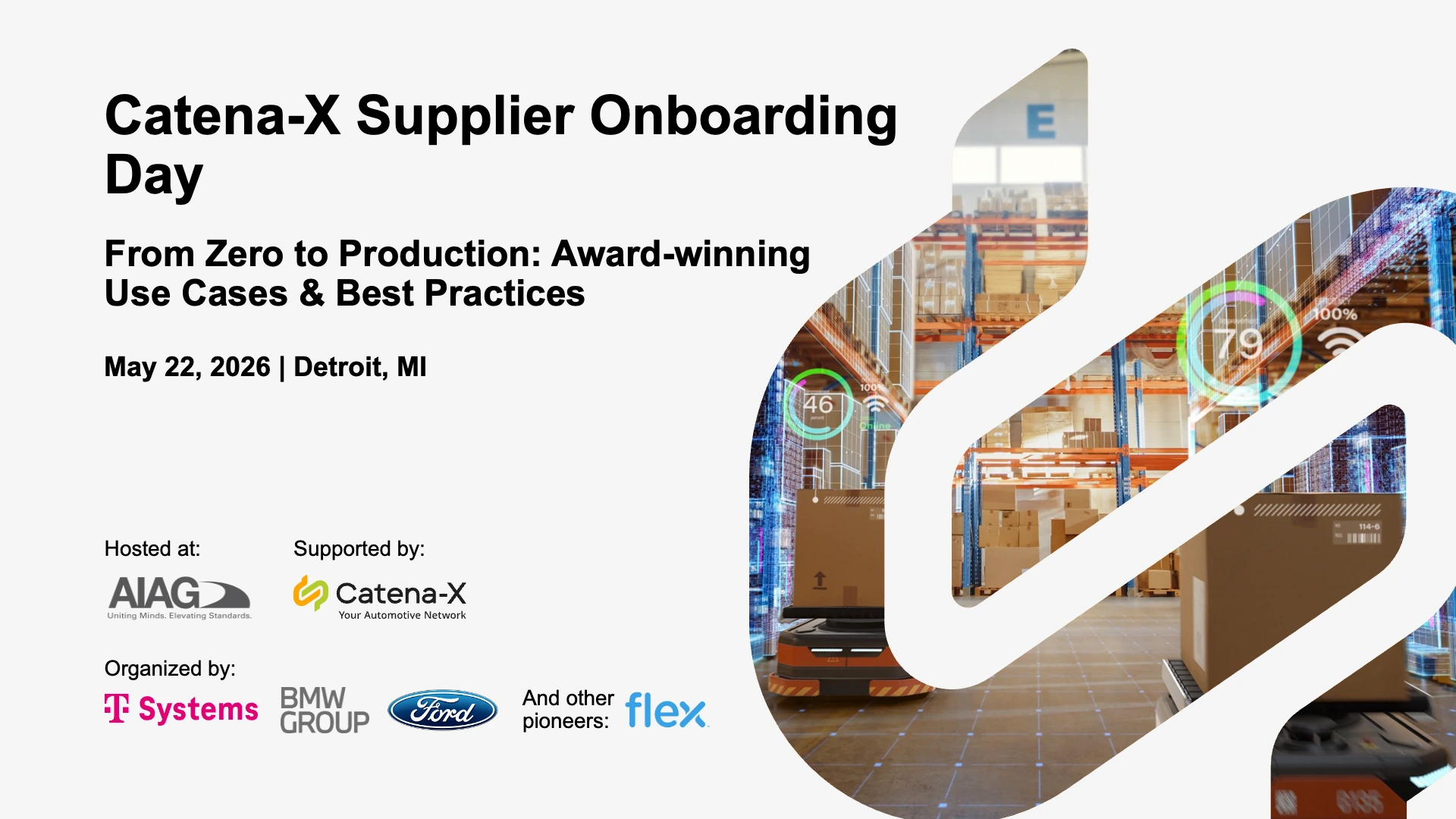
AIAG-Catena-X-SOD-Detroit 2026: AIAG conference & Supplier onboarding day
This article highlights the transition of Catena-X (CX) in North America from pilot initiatives to large-scale adoption within the automotive industry. It positions CX as a decentralized data ecosystem—an “Internet for data”—that addresses critical challenges such as quality management, sustainability compliance, and battery passport reporting. Drawing on insights from the AIAG Catena-X Conference and Supplier Onboarding Day in Detroit, the article emphasizes that digital transformation and AI initiatives are fundamentally data challenges, often hindered by fragmentation across organizations and supply chains. Catena-X provides a practical, business-oriented approach by combining trusted data-sharing infrastructure, ready-to-deploy use cases, and a scalable onboarding model for suppliers. The experiences shared by industry leaders demonstrate how CX accelerates time-to-value, enabling companies to transform fragmented data into interoperable, trusted data flows that underpin generative AI, digital twins, and future digital business models.
Read more
Chris S. Langdon
Jun 01, 2026