Verwaltung des Datenraums
Glossar Seite
Governance bezieht sich auf einen Rahmen von Regeln, Praktiken und Verfahren, die eine Organisation leiten und verwalten, sowie auf die Mechanismen, die sie und ihre Interessengruppen zur Verantwortung ziehen. Die vier Hauptsäulen einer guten Governance sind Transparenz, Fairness, Verantwortlichkeit und Sicherheit. Im Zusammenhang mit Datenräumen besteht eines der Hauptziele der Governance darin, die Datenverwaltung sicherzustellen. Governance in Datenräumen findet auf verschiedenen Ebenen statt, darunter Gesetze und Vorschriften, Governance gemeinsamer Bausteine und Vermögenswerte, sektorspezifische und datenraumübergreifende Governance, Governance spezifischer Datenräume und Selbstregulierung einzelner Datenraumteilnehmer.
https://dssc.eu/wp-content/uploads/2023/01/Starterkit-Interim-Version-Release-19-Dec-2022.pdf
Aktuelle Webinare






Aktuelle Artikel
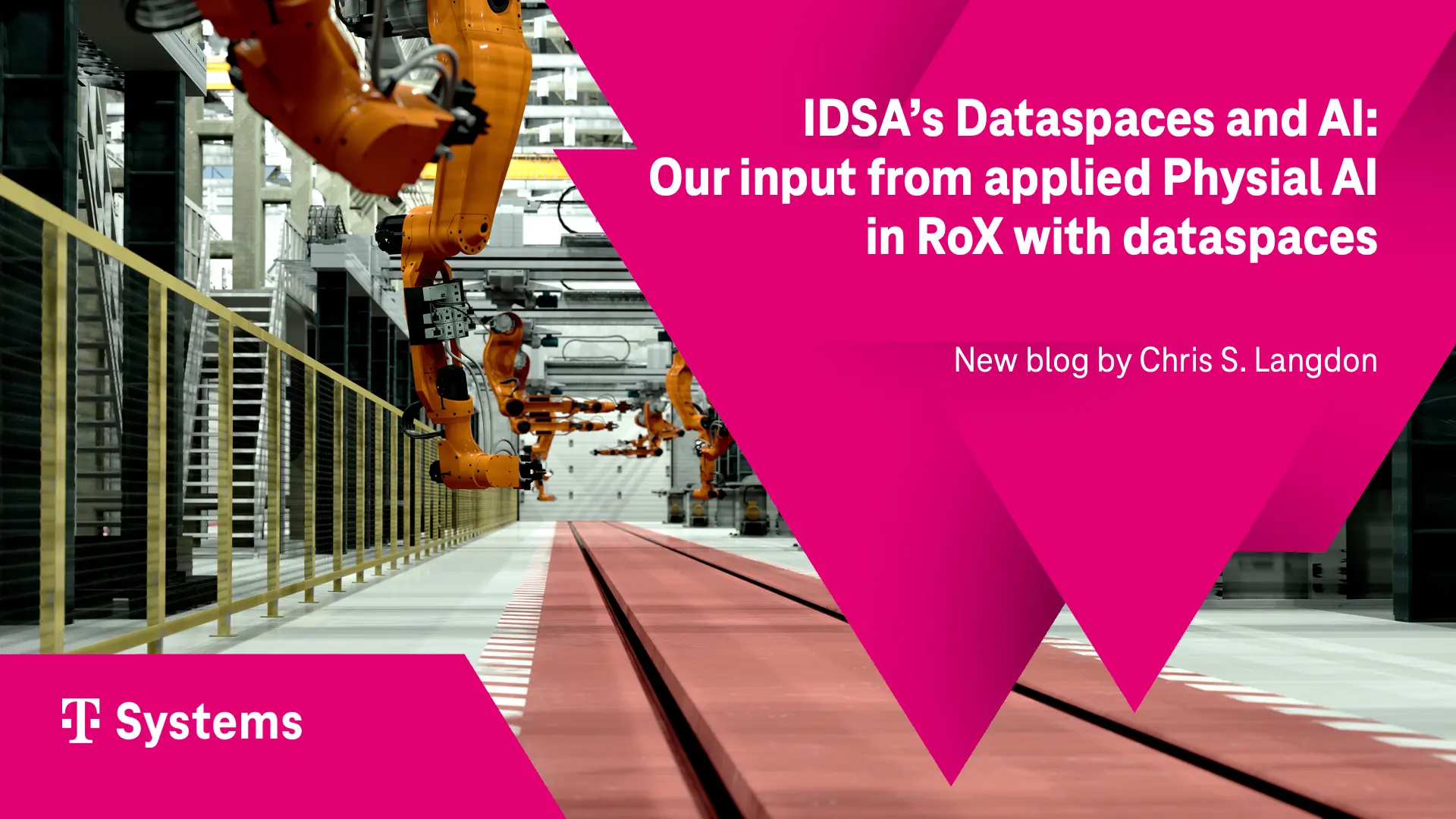
IDSA’s Dataspaces and AI: Our input from applied Physial AI in RoX with dataspaces
The IDSA position paper "Data Spaces and AI" argues that the coordination problems facing agentic AI — identity, trust, access control, governance and provenance across organizational boundaries — are the same ones dataspaces already solve for cross-company data sharing. Rather than reinventing them for autonomous agents, the peer-to-peer logic behind standards like ISO/IEC 20151 can transfer directly to agent-to-agent interaction. T-Systems contributes a concrete proof point: RoX, a German consortium where competing robotics players and institutes such as DFKI and DLR share a sovereign data foundation for AI-based robotics. Built on Tractus-X and aligned with IDSA and Gaia-X, it already powers live robotic cells and is now extending that governed data supply to an agentic layer — showing in practice what the paper argues in principle.
Weiterlesen

Chris S. Langdon
21. Juli 2026

First Korea–Europe peer-to-peer dataspace transaction: L&F and EU Tier 1
In November 2025, the first peer-to-peer dataspace transaction between Korea and Europe was completed, with L&F (Korea) sharing product carbon footprint data with the automotive division of a major European Tier 1. Orchestrated by Prof. Chaisung Lim of Konkuk University and enabled by T-Systems' Dataspace-as-a-Service, the exchange ran on the Eclipse Tractus-X stack with the IDSA protocol and Gaia-X trust framework — the same standards underpinning Catena-X. The transaction proves that sovereign, governed data sharing can now travel across regions and regulatory environments without centralising data or surrendering control. Beyond secure, trusted file transfer, it points to a strategic foundation for AI-ready data and new value-creation scenarios, including controlled collaboration across ecosystems and even between competitors.
Weiterlesen
Chris S. Langdon
29. Juni 2026

AIAG Catena-X SOD Detroit 2026: AIAG-Konferenz & Supplier-Onboarding-Tag
Dieser Artikel beleuchtet den Übergang von Catena‑X (CX) in Nordamerika von Pilotinitiativen hin zu einer breiten Anwendung in der Automobilindustrie. Er positioniert CX als dezentrales Datenökosystem – ein „Internet für Daten“ –, das zentrale Herausforderungen wie Qualitätsmanagement, Nachhaltigkeits-Compliance und Batteriepass-Berichterstattung adressiert. Basierend auf Erkenntnissen aus der AIAG Catena‑X Konferenz und dem Supplier Onboarding Day in Detroit wird hervorgehoben, dass digitale Transformation und KI-Initiativen im Kern Datenherausforderungen sind, die häufig durch Fragmentierung über Organisationen und Lieferketten hinweg erschwert werden. Catena‑X bietet hierfür einen praxisnahen, geschäftsorientierten Ansatz, der vertrauenswürdige Dateninfrastruktur, einsatzbereite Anwendungsfälle sowie ein skalierbares Onboarding-Modell für Zulieferer kombiniert. Die Erfahrungen von Branchenführern zeigen, wie CX die Time-to-Value beschleunigt und Unternehmen befähigt, fragmentierte Daten in interoperable, vertrauenswürdige Datenflüsse zu transformieren – eine wesentliche Grundlage für generative KI, digitale Zwillinge und zukünftige digitale Geschäftsmodelle.
Weiterlesen
Chris S. Langdon
01. Juni 2026