Opt-in / Zustimmung des Kunden
Glossar Seite
Ausdrückliche Einwilligung einer Person, in der Regel eines Kunden, in die Verwendung ihrer Daten. Es ist wichtig, dass die Person, die ihr Einverständnis gibt, vorab über die beabsichtigte Verwendung der Daten informiert wird. Jede weitere Verwendung erfordert eine gesonderte Anfrage für ein neues Opt-in. Außerdem dürfen nur die im Opt-in-Text angegebenen Geschäftsbereiche auf die Daten zugreifen und sie verarbeiten. Wenn das Opt-in beispielsweise für die Telekom Deutschland gilt, ist T-Mobile Austria nicht berechtigt, die Daten zu lesen oder zu verarbeiten. In der Regel wird ein Opt-in in schriftlicher Form eingeholt. Es wird empfohlen, sich bei der Abfassung des Opt-In-Textes von der Rechtsabteilung beraten zu lassen. Hinweis: In Deutschland ist das entsprechende Gesetz § 4a BDSG."
https://knowledge.hubspot.com/email/understand-opt-in-consent-for-email
Aktuelle Webinare


Aktuelle Artikel
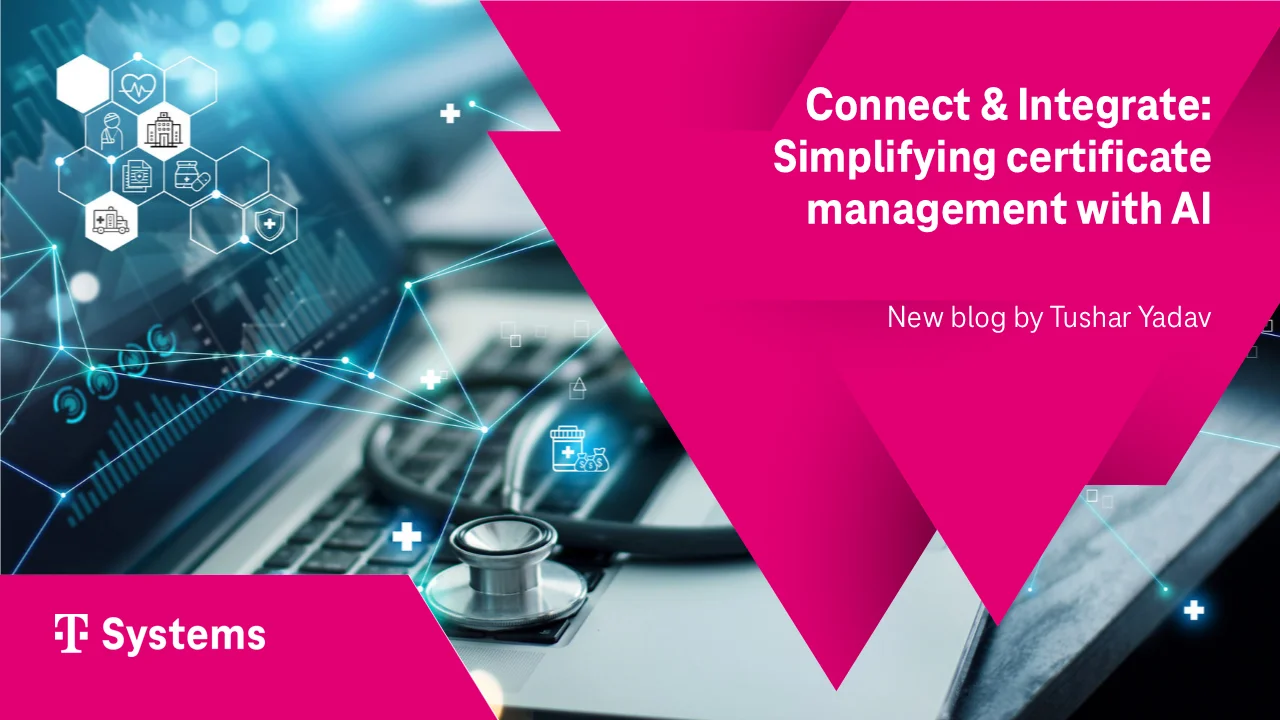
Connect & Integrate: Simplifying certificate management with AI
Connect & Integrate brings the T-Systems AI power within the solution to support organizations scale up and become efficient in their business workflows within Catena-X. The cross-use-case AI layer sits at the intersection of data preparation and exchange as a business enabler directly within the workflows.
Weiterlesen

Tushar Yadav
03. Aug. 2026
IDSA’s Dataspaces and AI: Our input from applied Physial AI in RoX with dataspaces
The IDSA position paper "Data Spaces and AI" argues that the coordination problems facing agentic AI — identity, trust, access control, governance and provenance across organizational boundaries — are the same ones dataspaces already solve for cross-company data sharing. Rather than reinventing them for autonomous agents, the peer-to-peer logic behind standards like ISO/IEC 20151 can transfer directly to agent-to-agent interaction. T-Systems contributes a concrete proof point: RoX, a German consortium where competing robotics players and institutes such as DFKI and DLR share a sovereign data foundation for AI-based robotics. Built on Tractus-X and aligned with IDSA and Gaia-X, it already powers live robotic cells and is now extending that governed data supply to an agentic layer — showing in practice what the paper argues in principle.
Weiterlesen

Chris S. Langdon
21. Juli 2026
First Korea–Europe peer-to-peer dataspace transaction: L&F and EU Tier 1
In November 2025, the first peer-to-peer dataspace transaction between Korea and Europe was completed, with L&F (Korea) sharing product carbon footprint data with the automotive division of a major European Tier 1. Orchestrated by Prof. Chaisung Lim of Konkuk University and enabled by T-Systems' Dataspace-as-a-Service, the exchange ran on the Eclipse Tractus-X stack with the IDSA protocol and Gaia-X trust framework — the same standards underpinning Catena-X. The transaction proves that sovereign, governed data sharing can now travel across regions and regulatory environments without centralising data or surrendering control. Beyond secure, trusted file transfer, it points to a strategic foundation for AI-ready data and new value-creation scenarios, including controlled collaboration across ecosystems and even between competitors.
Weiterlesen
Chris S. Langdon
29. Juni 2026