CES is where the tech industry pressure-tests “next” at scale. The Consumer Technology Association (CTA) describes CES as “the most powerful tech event in the world” and “the proving ground for breakthrough technologies and global innovators.” In 2026, that scale was visible: Nearly 150k attendees, 4k+ exhibitors (including approximately 1,200 startups), and 55%+ senior-level executives in attendance. At CES 2024, our debut with active participation, we launched with a highly operational Ford–Flex demo hosted by IBM (Schlueter Langdon 2024, IBM 2min video). This year, we elevated our presence with a CEO-level message: Industrial and Physical AI are accelerating, but real results require “truthful” data and digital twins, including decision-grade signals beyond enterprise boundaries across supply chains and market channels.[1] Dataspace technology, powered by distributed Web3 principles, has arrived in time to meet this challenge, enabling secure, sovereign data transactions across companies with built-in IP and usage-rights protection; in automotive, ecosystems such as Catena-X are already putting this into production: If it did not exist, it would need to be invented now. To deliver this message at CES loud and clear, and end-to-end from what to why to how, we were invited to join PwC’s panel on U.S. industrial reinvention and led three connected engagements during the week: executive thought leadership and exchange, open showfloor engagement featuring Catena-X participants and use cases, and Catena-X supplier activation and onboarding.

Figure 1: Chris Langdon with fellow executives on PwC’s CES panel on industrial reinvention
PwC Research Summit panel: The new industrial era – U.S. reinvention through tech & resilience
Tue, Jan 6 | 10:00–10:40 PST | LVCC West Level 2, W232
This conference session, organized and presented by PwC as part of the Research Summit, was selected by CES for West Hall’s main conference stage and framed AI, energy resilience, and sovereignty as the strategic drivers of a “new industrial era.” Figure 1 shows the panel brought together executive voices spanning mobility, defense-industrial innovation, and automotive technology: Ryan Hawk (PwC, moderator), Ger Dwyer (CIO, Rivian), Dr. Mark Maybury (VP Commercialization, Lockheed Martin), Anant Thaker (SVP & Chief Strategy Officer, Aptiv), and Prof. Dr. Chris S. Langdon (Deutsche Telekom and Drucker School).
Our contribution: Reframing “AI readiness” as data readiness, inside the enterprise and across supply chains, with governed sharing as the unlock for digital twins and Physical AI in production.

Figure 2: C-suite roundtable with AIAG, BMW, Denso, Flex, IAV, Rivian, Uber
Invitation-only C-suite roundtable hosted by T-Mobile: WHY data readiness for success with digital twins and industrial AI
Wed, Jan 7 | 10:30–12:00 PST | Aria Hotel, T-Mobile Meeting Room (Primrose 4)
Figure 2 highlights moments from our CES C-suite roundtable. This closed-room executive discussion made the board-level case for data readiness as a driver of growth, risk, and competitiveness in the era of truthful digital twins and industrial AI. The conversation centered on strategies, flagship use cases, and the emerging economics of turning sensitive internal and cross-company data into measurable advantage.
The roundtable was designed around the management logic of Peter Drucker, the inventor of modern management, and translated into the dataspace context. Moderated by Chris Langdon (Research Professor and Founder, Drucker Customer Lab, Claremont Graduate University), it was framed by a Drucker-derived hypothesis: “tomorrow is created today,” and the fastest path to the future is quick, customer-facing results[2]. Applied here: start with Catena-X today to deliver near-term outcomes in use cases such as quality and sustainability, while simultaneously building the scalable data foundation required for Physical AI.
The discussion opened with (1) an executive framing of the evolution of automotive data exchange, from early spreadsheets and fax to EDI and now Catena-X, presented by Kevin Piotrowski (CTO, AIAG), and (2) an overview of the 3-layer data ecosystem stack (dataspace network, data products, and apps) by Langdon. In addition, the exchange was enriched by short “impulse” contributions (with a supporting CEO 1-pager) from participants and pioneers of Catena-X and dataspace technology:
- Nicole Stevenson (Flex Automotive): Immediate benefits from reusing the same dataspace setup across multiple OEM customers and use cases, with practical examples
- Michael Frans and Carsten Rinka (IAV): Using the new stack inside-out as an internal enterprise dataspace for unified data governance and cross-silo data products for more relevant GenAI outcomes with software-defined vehicle and autonomous driving solutions
- Philipp Kassack (BMW Group): How Catena-X supports BMW’s broader digital and AI transformation most visible in its first new generation, Neue Klasse, iX3 vehicle
Partners and roles: The roundtable was hosted by T-Mobile, supported by AIAG, organized by T-Systems, with participants from BMW, Denso, Flex, IAV, Rivian, and Uber.

Figure 3: Shopfloor panel on Catena-X with early adopters and success stories
Showfloor panel at Deutsche Telekom IoT booth: Catena-X in action, data readiness for digital twins and AI
Tue, Jan 6 | 11:00–12:30 PST | LVCC West Hall, Booth 3177
Figure 3 presents selected impressions from our showfloor panel. Hosted openly on the CES showfloor at the Deutsche Telekom IoT booth, this session was designed for maximum accessibility, with no registration required. It focused on the Catena-X data ecosystem, highlighting that dataspace technology has moved beyond pilots and is operating in production with real use cases, including Certificate Management, Quality, and Sustainability.
The format was a practical panel that translated “big ideas” into “what’s working now,” including scaling patterns and quick wins for making data AI-ready across internal silos and company boundaries. Panel perspectives were intentionally MECE: Kevin Piotrowski (CTO, AIAG) provided the industry view, Philipp Kassack (BMW Group, Catena-X onboarding lead) represented the OEM perspective, and Nicole Stevenson (Flex, VP Marketing & Strategy) brought the Tier-1 view. The session was hosted by DT IoT, organized and moderated by Prof. Dr. Chris S. Langdon, with support from AIAG’s Kevin Piotrowski.
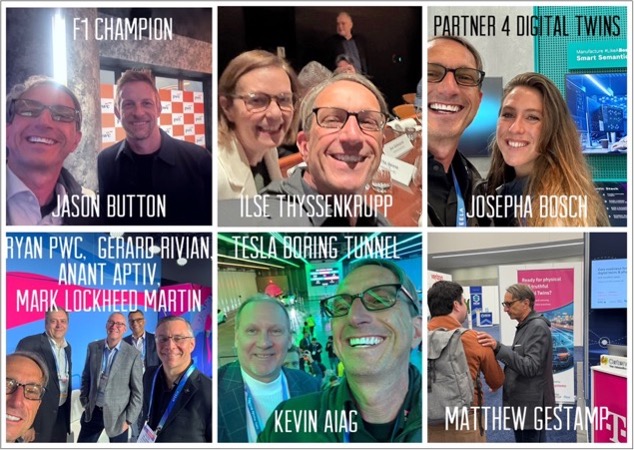
Figure 4: From the track to the boardroom – CES is where speed meets strategy
Catena-X supplier onboarding at Aria … Catena-X supplier onboarding
Wed, Jan 7 | 15:00–16:30 PST | Aria Hotel, T-Mobile Meeting Room (Primrose 4)
This invitation-only session shifted to supplier activation and the practical mechanics of joining Catena-X for production outcomes. It followed the same onboarding playbook as our Oct 3 Supplier Day at AIAG HQ in Detroit, tailored to the CES audience and timed to move interested suppliers from intent to action.
The agenda was deliberately structured for speed: welcome and framing by AIAG’s CTO Kevin Piatrowski for Catena-X-Hub-North-America together with Chris Langdon (CX-Hub-NA/ Deutsche Telekom), a Catena-X and CX-Hub-NA overview, a use-case deep dive across Certificate Management, PCF, and Quality (with OEM/Tier-1 perspectives), followed by a “getting started” segment, everything needed to create value quickly, and closing Q&A/networking.
Ecosystem setup: hosted by T-Mobile, supported by AIAG, organized by T-Systems, with invitations by BMW Group (closed registration).
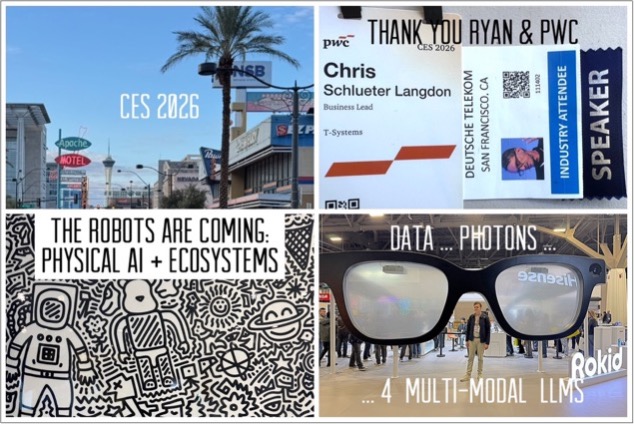
Figure 5: CES 2026 impressions and takeaways
What we learned and reinforced at CES 2026
Figure 4 and Figure 5 are a collage of CES impressions and meetings across the spectrum, from a F1 champion to tech innovators and board-level leaders, providing rich inputs from multiple directions that underpin the synthesis and two takeaways that leaders can’t ignore: AI is turning into infrastructure, and ecosystems are moving into production.
1) AI goes Internet: from wow-factor to background infrastructure. “The robots are coming” and Physical AI is becoming embedded in daily life and business, like Wi-Fi, which means leaders can no longer treat AI as a side program. CES made that “infrastructure moment” tangible: GenAI is accelerating Industrial and Physical AI, pushing data readiness inside the enterprise and across supply chains onto the CEO agenda. Across our CES engagements, the conversation moved from “AI demos” to operating requirements: how to get the right data for “truthful” digital twins, how to scale across global supply chains, and how to turn sensitive internal and cross-company data into measurable advantage.
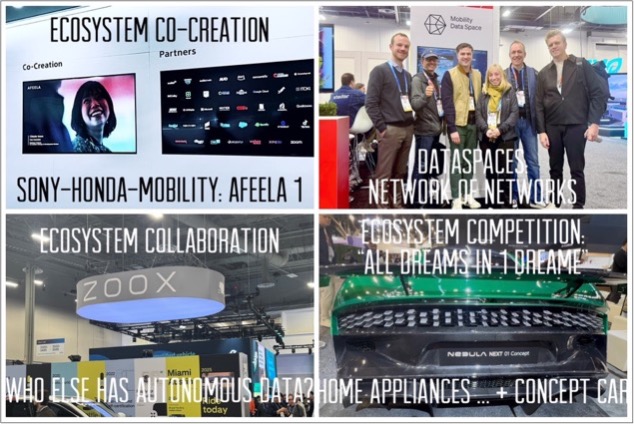
2) From product ecosystems to PRODUCTION ecosystems (supply chains + factories + partners).
The second takeaway makes a strategic leap: the ecosystem playbook is moving into industry. Figure 6 illustrates various ecosystem flavors underling a key thread running through the show: ecosystems win when data flows and everything just works, and industry now needs that same default interoperability, but with trust, control, and IP protection. Physical AI needs best data products (digital twins, provenance/ lineage/ governance) and data sharing across silos, companies, and regions, making it “perfect timing” for Web3-oriented dataspace technology that enables cross-company sharing with IP protection and is already live in automotive with the Catena-X data ecosystem.
Deep dive: Insights, lessons learned, business impact
- Dataspace-CEO-2-pager: What is … data ecosystem … dataspace … 3-layer stack?
- RoX, our AI-Data frontier project in robotics: 2024 launch, Automatica demos 2025
- Our CES history: CES 2025 IAV CEO/ LinkedIn, CES 2024 video/ LinkedIn, CES 2023 story
References
Davenport, T. H., and P. Tiwari. 2024. Is your company’s data ready for generative AI? Harvard Business Review (April), link
Drucker, P. 1995. The information executives truly need. Harvard Business Review (January-February; winner of the HBR McKinsey Award for the year’s best HBR article): 54-62
Drucker, P. 1980. Managing in turbulent times. Harper & Row: New York, NY
Drucker, P. 1954. The practice of management. Harper & Row: New York, NY
Guggenberger, T. M., C. Schlueter Langdon, and B. Otto. 2025. Data Spaces as Meta-Organisations. European Journal of Information Systems, January: 1–21, link
Kim, C., and R. Mauborgne. 2004. Blue Ocean Strategy. Harvard Business Review (October), link
Schlueter Langdon, C. 2024. CES 2024: PCF Pilot with Catena-X Technology. Industry event report (E14, 2024-02-15), Drucker Customer Lab, Peter Drucker School of Management, Claremont Graduate University, Claremont, CA, link
Schlueter Langdon, C. 2021. Catena-X With GAIA-X: Will Data Space Be the Word of 2021? IDSA Blog (2021-03-21), International Data Spaces Association, Berlin, link
[1] Our theme is rooted in Drucker’s view of the extended enterprise as an “entire economic chain,” spanning supply chains and channel systems, a perspective he advanced for total cost management and yield maximization (Drucker, 1995), and that we now translate into the question of “Is Your Data Ready for AI?” (Davenport & Tiwari, 2024).
[2] Drucker distilled the essence of business early on as “creating a customer” (Drucker 1954), emphasizing that “the only profit center is a customer’s check that doesn’t bounce” (Drucker 1995). Furthermore, a sustained focus on customer centricity, he argued, helps leaders manage the tension between short-term performance and long-term relevance, because “tomorrow is being made today” (Drucker 1980), so meeting today’s targets should also build future success.